

🥊 What do voters really want from the Democratic Party? We asked.
Fighting back is good policy and good politics.

Should Democrats be more moderate or double down on being lefty? That’s been the central Beltway debate since losing in 2024. But new polling Upper Cut released today suggests that’s the wrong question. Fights about ideology may dominate cable news panels, but for voters — the real test is toughness.
Take Virginia, where Dems got aggressive … and won: In principle, voters hate political gerrymandering: around three-quarters of Americans — and a whopping 83% of Democrats — say it’s unfair and a major problem. But in Virginia, Democrats leaned into a hardball redistricting fight — and last week voters, especially Democrats, rewarded it, approving a map that could hand the party a major advantage in Congress. Voters didn’t suddenly fall in love with gerrymandering. But when the choice was framed as a fight — win or lose, power or surrender — they wanted to throw a punch.
Get tough or die: Our new poll conducted earlier this month reinforces why that’s the right choice. We found that voters aren’t predominantly focused on ideological tests. They’re looking for strength over weakness and want the Democratic party to stand up.
By a more than two-to-one margin, Democratic and independent voters said that “someone who I see as fighting to get things done” (69%) mattered more than “someone who I agree with on most issues” (31%).
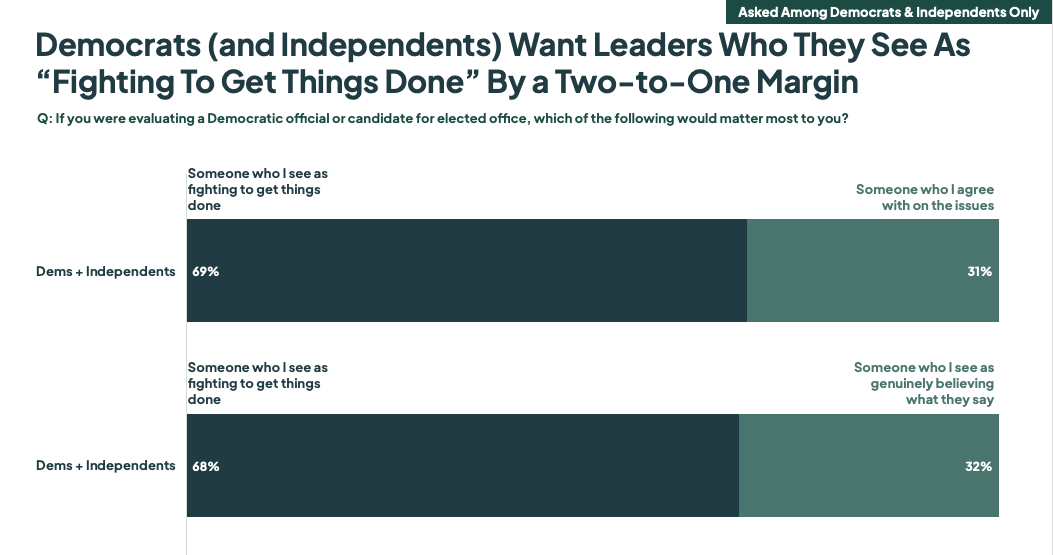
Shift the conversation: It’s why a debate focused solely on whether the party should move left or right ideologically misses the mark. We shouldn’t just assess a position based on whether it’s liberal or moderate, but on whether it shows timidity or toughness.
No matter which direction the Democratic party moves ideologically — or who the nominee is in 2028 — the base and persuadable voters want the Democratic party to fight harder and more effectively. It’s a clear justification for them to get tougher on Trump today.

THE TOPLINES
Our poll, conducted by Loft Beck Strategies, surveyed more than 1,500 voters (plus an oversample of 402 self-reported Democrats) about their views on the Democratic party and its direction.
Three big takeaways:
Takeaway #1: Voters are mixed on ideology, but united on strength.
Not only do voters care more about strength than ideology in a head-to-head, but focusing on strength also allows us to grow the tent. Why? It’s obvious: 58% of Democrats want the party to move left, but only 33% of all voters agree.
There’s far more alignment on strength. 87% of Democrats want a leader who will fight Trump — a number that only dips to 49% among all voters.
If you’re on the growing list of 2028ers, the message is clear: to win in the primary and the general, focus on the fight.
Takeaway #2: The party’s most popular leaders are also viewed as its strongest — and they span the ideological spectrum.
When it comes to favorability, strength also trumps ideology. Take leaders like IL Gov. JB Pritzker (+52 net favorability, +46 net strength among Democrats), AZ Sen. Mark Kelly (+51, +48 among Democrats), VT Sen Bernie Sanders (+75, +67 among Democrats) and NY Rep. Alexandria Ocasio-Cortez (+67, +68 among Democrats). Despite representing different ideological factions within the party, all four have high net favorability and high net strength ratings among Democrats.
When looking at all voters, favorability and perceptions about strength are also closely aligned. But when it comes to favorability and ideological positioning, it’s more complex:
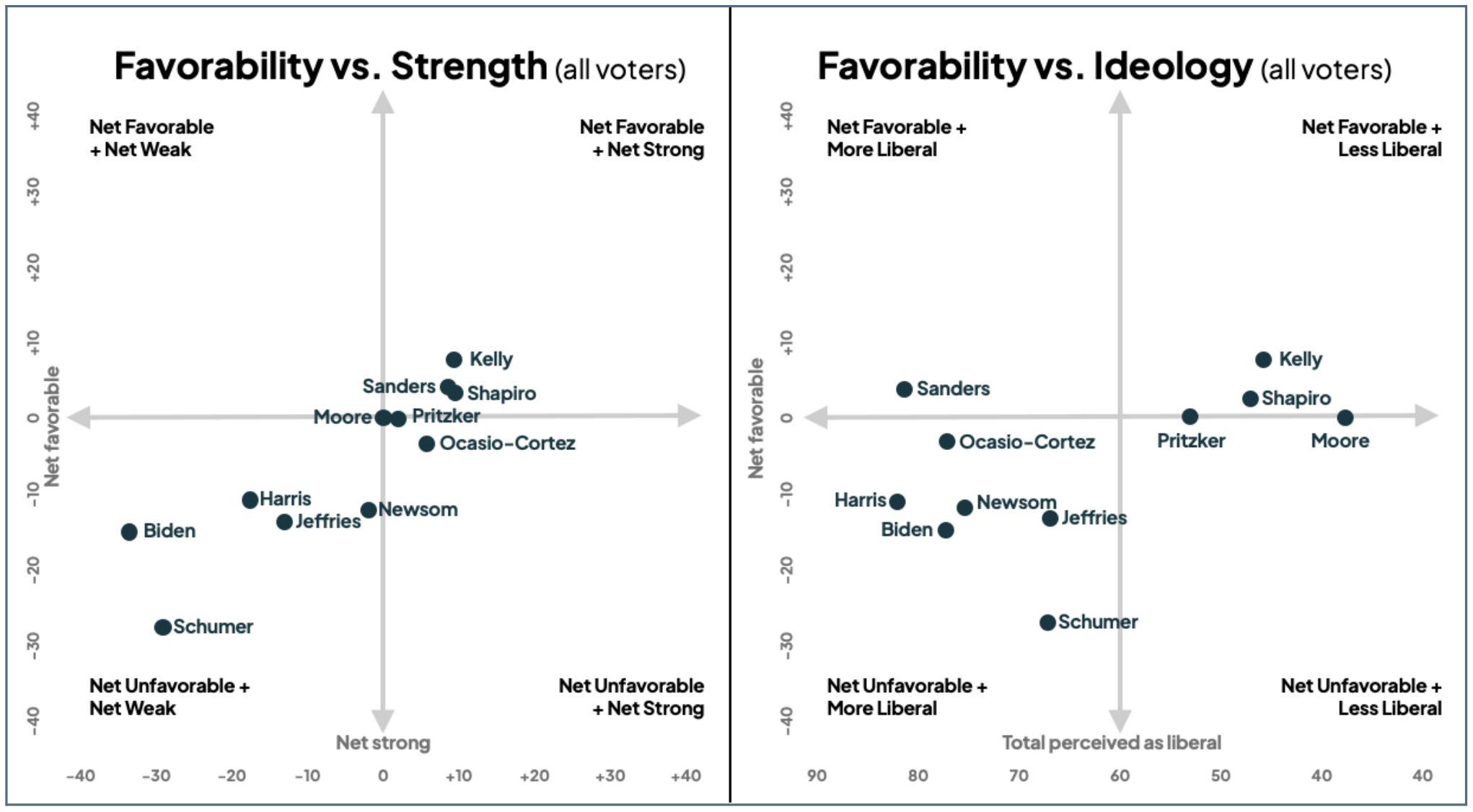
“Strength” can come in many forms. Gov. Pritzker has led the efforts to fight back against ICE. Sen. Kelly didn’t back down when Pete Hegseth tried to censure him. AOC never misses an opportunity to speak authentically about Trump’s abuses. And Bernie? Fighting the powerful is his personal brand.
At the other end of the spectrum, the data shows that one of the least popular figures among Democratic voters and all voters, Senate Minority Leader Chuck Schumer (-28 net favorability, -30 net strength among all voters), is also perceived as one of the weakest. Not helping Schumer’s perception: his tepid rhetoric, like his statement after Trump’s attacks on Iran, asking for “details” rather than taking the fight to the administration over its illegal war.
Takeaway #3: Strength isn’t just about the future — it’s about how to confront the challenges posed by Trump today.
Among Democrats, we found majorities believe the party knows what’s best for the country (86% agree), has a clear vision (57%), and gets things done (54%). Better than we thought!
The only dimension tested in our survey where a majority of Democrats express dissatisfaction with the party? Effectively standing up to Trump.
With Trump deeply underwater and “strength” viewed as such an important characteristic, it’s clear what Democrats should do: punch back.
Of course, strength isn’t the only factor. Voters also strongly favor Democrats putting forward bigger ideas (+50), acting with authenticity (+46), and proposing a forward-looking agenda (+34). But on each of those vectors, strength can be additive. And that’s why it can’t be overlooked.
As always, we’ve got some ideas — and recent examples — about where Democrats can start.

THE DATA
Want more from the poll? Here’s everything we have — plus a take from one of our friends:
Memo: HERE
Toplines: HERE
Crosstabs by Demographics: HERE
Crosstabs by Partisanship: HERE
Deck: HERE
Full Crosstabs (Excel): HERE
Jesse Lehrich’s take in Nobody’s Listening
THE PUNCH LIST
Are you a local prosecutor? Hold federal officials criminally accountable. On April 16, Hennepin County Attorney Mary Moriarty indicted a federal official on felony assault charges for brandishing his weapon at occupants of a vehicle. Her take: “There is no such thing as absolute immunity for federal agents who violate the law in the state of Minnesota.”
Work for a Governor? Help local prosecutors build a case. In Illinois, Gov. Pritzker established the Illinois Accountability Commission to collect testimony, hold hearings, and gather information on rogue feds. In Minnesota, Gov. Tim Walz set up a Truth Council to do the same. Both will preserve critical evidence that can be used for the accountability that’s coming.
Work for California AG Rob Bonta? Fight back against MAGA’s media takeover. When the FCC was ready to rubber stamp the Nexstar/Tegna merger, a coalition of eight state AGs sued to block it — it’s now on hold. Next up? Paramount/Warner Bros. Last week, more than 1,000 writers, actors, and directors courageously spoke out encouraging AG Bonta to take action. He should fire up the state’s antitrust authorities.
Trying to fill a gap in your state budget? Use state economic power as a sword against corporate enablers. If corporations want to profit off Trump’s immigration agenda, states can hit them where it hurts. In Delaware, State Sen. Raymond Siegfried’s bill would strip jet fuel tax breaks from airlines that transport ICE detainees without due process, turning a subsidy into leverage. In New Jersey, State Sen. Raj Mukherji’s bill would place a 50% tax on private detention facilities and use that revenue for an Immigrant Protection Fund. When corporations help carry out an authoritarian agenda, they are no longer just bystanders — they’re participants. Blue states should send a clear message: if you participate, we’ll make you pay.

THE BOTTOM LINE
We called up our pollster, Loft Beck Strategies Principal Bryan Bennett, to ask him to sum this all up for us:
“It’s pretty simple: if Democrats want to improve their brand and expand their coalition, they need to show voters that they have a backbone. Voters across the board want leaders who show strength and have a vision of who they are fighting for and what they are fighting against.”
Upper Cut is a collaboration between Salt River Valley Project and Evergreen Legal — two organizations that believe punching back is the policy playbook this moment demands. It’s how we fight a rigged system, make courage contagious, and deliver for people against the leaders holding them down.